Kalia Papadopoulou, Basketball Coach, AEL Limassol (Men’s Team)
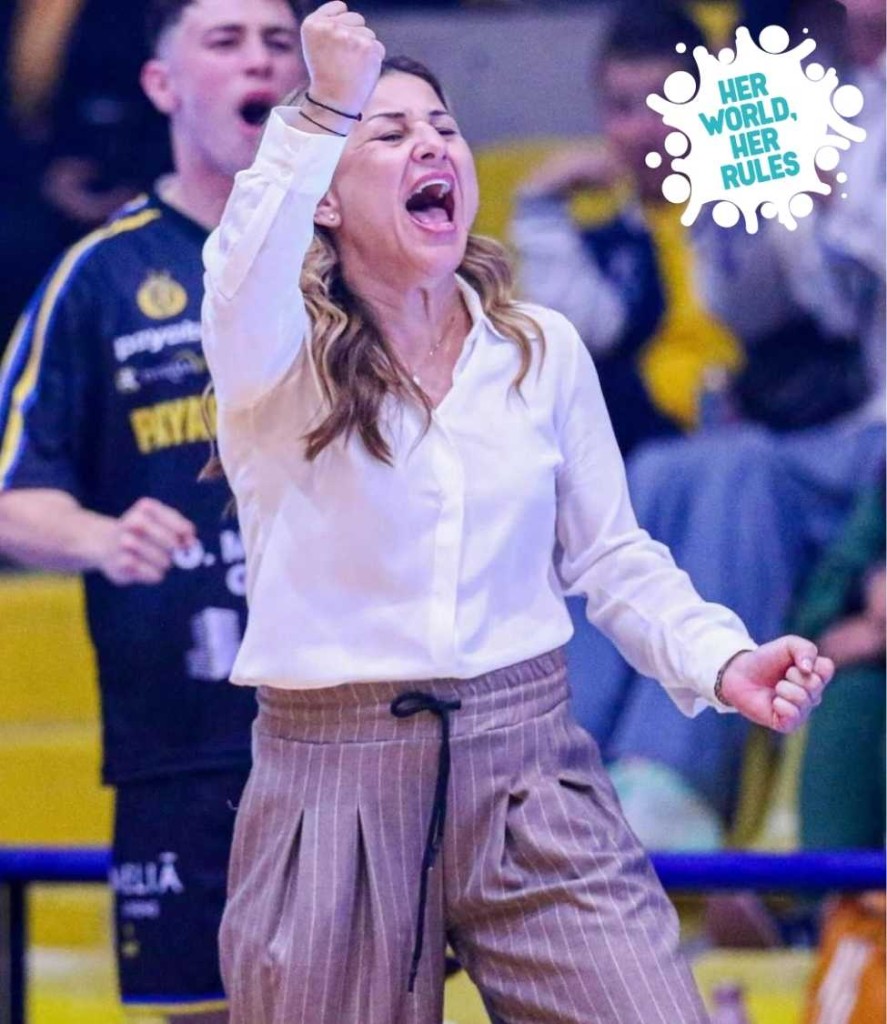
Kalia Papadopoulou is a distinguished Cypriot basketball player and coach with over two decades of experience in professional basketball. She earned her degree in Physical Education and Sports from Aristotle University of Thessaloniki (1998–2003) and has been teaching Physical Education at the Grammar School of Limassol since 2010. As a player, she had a prolific career from 1992 to 2017, representing top clubs in Cyprus, Greece, and France, including AEL Limassol, Megas Alexandros Thessaloniki, Thermaikos Thermi, and Laveron (France). She captained AEL Limassol and the Cyprus Women’s National Team, leading her teams to multiple championships, cups, and international medals. Her personal achievements include being named Cyprus’ Best Female Basketball Player seven times.
Transitioning into coaching, Kalia has guided youth, women’s, and men’s teams, including the Cyprus Women’s National Team. She has won multiple championships and cups as a coach and continues to serve as the head coach of AEL Limassol’s men’s team. In 2019, she was appointed Ambassador of Fair Play, reflecting her lifelong dedication to sportsmanship and excellence.
What challenges do women coaches face compared to their male counterparts?
Women coaches often face challenges related to recognition, credibility, and opportunity. There is still a prevailing perception that men are more experienced or better suited, especially in mendominated sports such as basketball. Many times, we have to work harder to prove our worth and be taken seriously. Additionally, the lack of women role models in high-level positions makes the journey even more difficult.
Have you ever faced discrimination or bias as a female coach? How did you handle it?
Women often face underestimation in the professional sphere, and this is not limited to sports. In basketball — a traditionally men-dominated field — this becomes even more apparent. It’s no coincidence that across all of Europe, there is only one woman coaching a men’s professional team. This underestimation isn’t always expressed openly through words. It can appear in a look, a reaction, an awkward silence, or a subtle lack of trust. It stems from a deeply rooted mindset born of patriarchy — the belief that a woman “doesn’t belong here.” The sports world carries this mindset, consciously or unconsciously. Personally, I haven’t felt openly disrespected, but I have sensed jealousy or suspicion toward me, simply because I’m a woman. I never paid much attention to it. I prefer to let my work speak for itself. I believe that consistency, professionalism, and passion become evident over time — and ultimately earn respect. A characteristic example is last year’s season with the men’s AEL team, which finished third in the standings after 15 years and defeated all the top teams. Had this been achieved by a man coach, it’s almost certain that social media and the press would have highlighted it far more. I don’t say this out of complaint — it’s simply an observation. And it’s one that shows we still have work to do before we can claim true equality in practice, not just in words.
What steps can be taken to encourage more women to pursue coaching careers?
Representation plays a decisive role. We need to see more women coaches at all levels so that young girls know this path is possible. At the same time, mentoring programs, leadership development initiatives, and equal opportunity policies are essential. Organizations, clubs, and academies must make genuine investments in the advancement of women in the coaching profession.
What inspired you to become a basketball coach, and did gender play a role in your journey?
I played basketball for 25 years. It was — and still is — a major part of my life. From the moment I stopped playing, I knew I wanted to stay in the sport — I couldn’t imagine my life outside the court. Coaching was the natural next step for me. I had already started coaching while I was still playing, so the transition came smoothly. There wasn’t a specific moment or person that inspired me — I just knew this was what I wanted to do. As for my gender, I never saw it as an obstacle. On the contrary, it gave me extra motivation to prove that women absolutely belong in coaching.


