Flora Anastasiou, National Basketball Coach
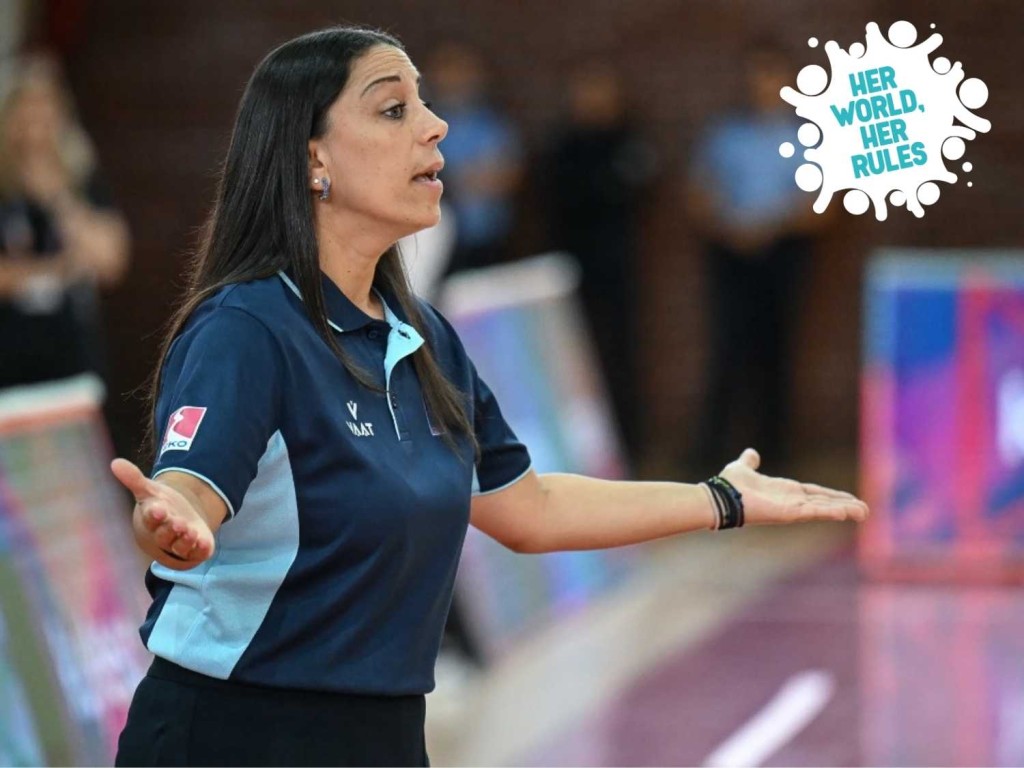
My name is Flora Anastasiou, and I am a Greek Cypriot National Basketball Coach. I was born in Larnaca, I come from Xylotymbou, and I am married and the mother of six children. I completed my studies at the University of Athens, at the Department of Physical Education and Sport Science (TEFAA), with a specialization in basketball.
As an athlete, I played for several teams in Cyprus (Kimon Xylotymbou, SPE Ormideias, AEK Larnaca) as well as in Greece (AS Pera Athens, Ilioupoli Academy), achieving many individual and team distinctions. At school sports level, I won two Pancyprian titles as a player with Xylotymbou Gymnasium and Pancyprian Lyceum of Larnaca. I also participated in the final phase of the World School Championship held in Ankara in 2001. I was also an international player, competing with the Cyprus U18 Women’s National Team in 2001 at the European Championship of Small Countries of Europe.
As a coach, I started my career in Greece with AS Pera Athens, Near East, Patissia, and others. Since 2019, I have been working at AEK Larnaca. I have experience in development teams for men and women, as well as in school sports, working at the Vergina Sports Schools in the basketball department. As a coach with the Sports Gymnasium, we won the Pancyprian Championship in 2025. In addition, as a Gymnasium and Lyceum coach at Vergina Larnaca, I have achieved seven provincial school championship titles. At the same time, last season I took on the role of National Coach for the Cyprus Women’s U16 National Team, where we won the FIBA European Championship Division C and achieved promotion to Division B in Europe.
What challenges do female coaches face compared to their male colleagues?
Female coaches face many challenges compared to male coaches, mainly linked to stereotypes, institutional inequalities, and prejudice. These challenges greatly affect their professional path, development, and daily life. Many times, we see dismissive behavior toward women, coming from a work environment dominated by male culture, where women’s skills and abilities are constantly questioned. As a result, female coaches are often overlooked during hiring processes, and less qualified men are chosen instead.
In terms of salary, male coaches are often favored, even when coaching women’s teams. This leads others to believe that women are less knowledgeable or less authoritative than men, forcing them to constantly prove their value due to lack of support from leadership. Female coaches are expected to work under intense pressure to prove themselves twice as much, making it difficult to balance professional and personal life.
Many women wish to start a family but are discouraged from entering or staying in coaching because of demanding schedules. This often leads to low self-confidence and a sense of isolation within an already male-dominated environment.
Have you ever experienced discrimination or prejudice as a female coach? How did you deal with it?
Yes, I have experienced discrimination and prejudice as a female coach, and unfortunately it is frequent and takes many forms. One of them is the questioning of competence and knowledge, which often leads clubs to choose male coaches with fewer qualifications.
There is also criticism that women are considered too “weak” to manage a team because they are seen as more approachable and pleasant by nature. In addition, there are sexist comments from colleagues and parents, such as “what does a woman know about basketball?” or “I don’t want my son to be coached by a woman.”
Personally, I dealt with this in a very strong and determined way, mainly through persistence and self-confidence. I focused on my work, continued my education and training, which strengthens credibility and acts as a strong response to prejudice. Communication with management, parents, and players is also very important, as it allows people to know you as a person and helps change their views.
Networking with other female coaches also helped a lot. Mutual support helps change the culture and promotes gender equality in sports.
The challenges are real, but persistence, willpower, confidence, and collective action can overcome obstacles and help create a more inclusive sports environment.
What can be done to encourage more women to pursue a coaching career?
To encourage more women to follow a coaching career, a multi-level approach is needed, including institutional changes, support, education, and a shift in mindset.
Mentorship programs where experienced female coaches guide younger ones can offer knowledge, confidence, and professional connections. Financial support and sponsorships are also needed to make coaching careers more sustainable.
Highlighting successful female coaches, especially at high levels, can inspire others by showing that women can succeed in male-dominated spaces. Sports organizations should ensure transparent hiring processes, focusing on qualifications rather than gender
Flexible working hours and parental leave are also important, helping women balance work and family life. Addressing stereotypes through federations and clubs, and promoting a culture of respect for female coaches, is essential.
Creating a positive environment and raising awareness among players, officials, and the media about the challenges female coaches face is key to changing social attitudes.
What inspired you to become a basketball coach, and did your gender play a role in this journey
From a young age, I was involved in sports in general, such as athletics, basketball, and volleyball, mainly because of my father. Growing up in the 1990s, basketball was developing rapidly in Greece and Cyprus. I started watching Greek league games and the NBA, which sparked my interest in basketball, and I joined a team in my village.
In a short time, I was selected for national team training groups and became a member of the U14, U16, and U18 National Teams, winning the gold medal at the European U18 Women’s Championship of Small Countries of Europe.
Later, I studied in Greece at the National and Kapodistrian University of Athens, at the Department of Physical Education, where I began to see basketball from a coaching perspective. I was strongly drawn to coaching and combined my studies with coaching work. I had many successes as a young coach.
Of course, my gender played a role throughout my career and continues to do so. In my early steps, I faced strong challenges and sexist comments from male colleagues and opponents, including ironic remarks after my team defeated theirs. However, I was very fortunate to work with supportive colleagues at AS Pera. I was the only female coach, but the relationship with management and colleagues was excellent. This support from the beginning of my coaching career helped me face difficulties more easily, and I am grateful for that.
Throughout my journey until today, the challenges remain many, but through hard work and professionalism, I feel stronger and more confident.
I would like to end with an incident we experienced in Kosovo with the Cyprus Women’s U16 National Team in 2025. Most teams had male staff, and their behavior toward us was dismissive and unacceptable. I will not go into details. However, when we won the gold medal in Division C, that behavior completely changed in a positive way. Unfortunately, this shows that a female coach must constantly prove her value through her work.


