
Athina Papagianni, Youth Coach, Keravnos Strovolou
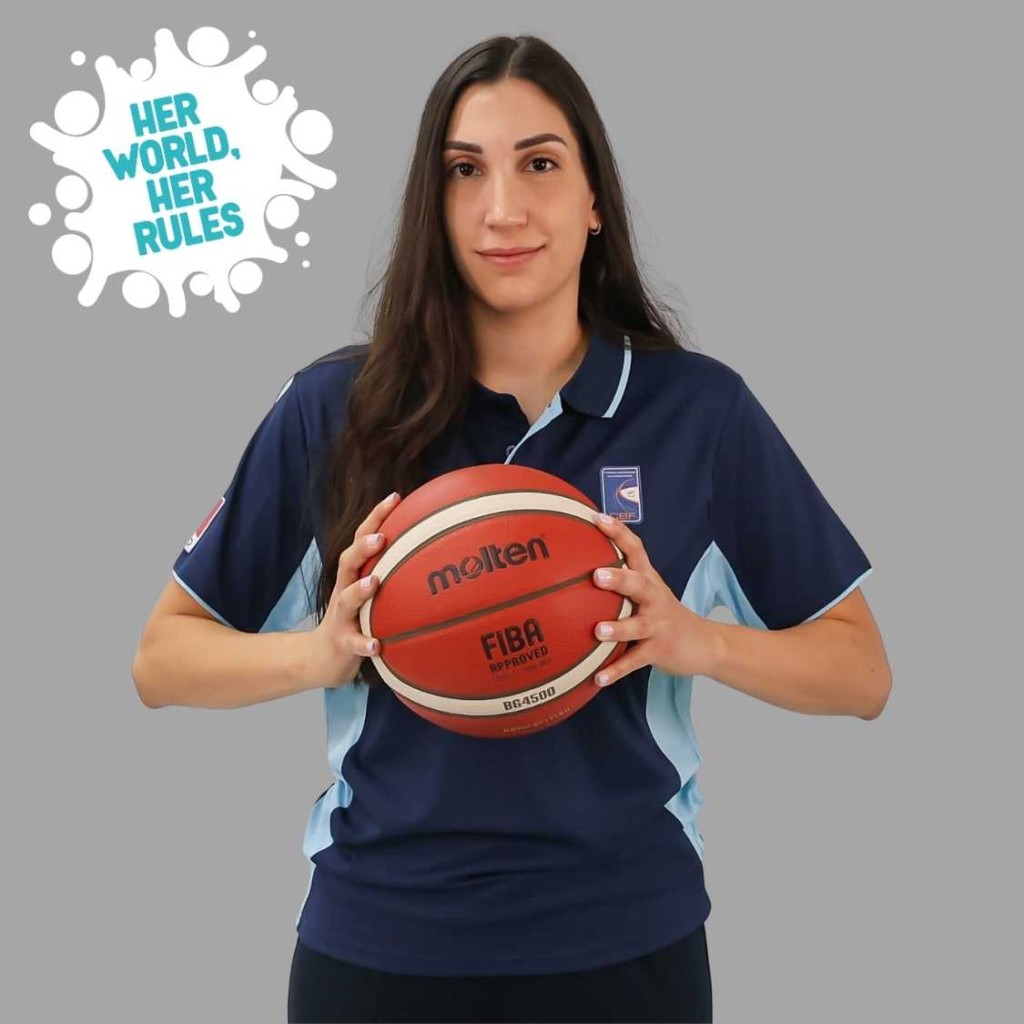
Athina Papagianni started her coaching career in 2018 with children under the age of 8, while she herself has been involved in basketball since a very young age.
She studied Business Administration and Public Administration at the University of Cyprus and then completed her postgraduate studies in Sport Business Management at Sheffield Hallam University in England, graduating with Distinction. Realizing her interest in coaching, she attended the Coaches School of the Cyprus Basketball Federation, successfully completing all three levels.
She has worked as a coach with various teams and age groups. Since 2023, she has been working at Keravnos Strovolou, where she coaches girls under 14, while also serving as assistant coach for the women’s U16 and U18 teams. In the 2024–2025 season, all three of these teams finished in first place in their elite categories. Since 2024, she has also been an Assistant National Team Coach for the Cyprus Women’s U16 National Team. The team won second place at the FIBA European Championship Division C, and in July 2025 they won first place in the same championship, earning promotion to Division B.
Alongside her coaching career, she holds a FIBA statistics license, has participated as a player in the Unified National Basketball Team at the 2023 Special Olympics World Games in Berlin, where the team won second place, and has also worked as a volunteer at the EuroLeague Final Four in 2022 in Belgrade.
What challenges do female coaches face compared to their male colleagues?
I believe that the situation is very different for women and men coaches. Women are not judged based on their knowledge and abilities, but on their gender, their appearance, and the different way they manage their players compared to men. Very often, women at clubs are assigned to coach younger age groups, while men take on the older ones. It is also uncommon for a female coach to lead a boys’ competitive team, while the opposite is very common with girls’ teams. There is a stereotype that men are more capable coaches regardless of knowledge or experience, and when a woman succeeds in higher levels, even up to a men’s first division team, it creates surprise. More often, a female coach will be judged for what she wears, her makeup, how loud her voice is, rather than for her tactics, coaching philosophy, or decisions.
Have you ever faced discrimination or bias as a female coach? How did you deal with it?
I have experienced several incidents so far that have made me realize the sad reality in my country regarding discrimination between women and men, especially in sports. These include behaviors from colleagues who would have acted differently if they were dealing with a male coach, lack of proper sports clothing for female coaches, parents of athletes who, because I am a woman and younger than them, believed they knew better than me what should happen on the court, and comments even about the jewelry I was wearing. I deal with this by ignoring such comments and letting my work show whether I am good at what I do.
What steps can be taken to encourage more women to pursue a coaching career?
Small and steady steps are needed to change the situation. I believe the first move must come from the Federation and then from the clubs. With female role models, more girls will believe that a coaching career is not an unrealistic dream. Women need to be given opportunities to take charge of more teams, and as a society we must show that we support and trust women in leadership roles and that we give them equal opportunities to those given to men. Mindsets and prejudices certainly do not change overnight. However, by observing the successful careers of female coaches abroad, I want to believe that we too will be able to develop great female coaches.
What inspired you to pursue a career as a basketball coach, and did gender play a role in your journey?
I was a basketball player myself, and when I happened to take on a coaching role with a team, I immediately fell in love with it. Coaching is a profession you cannot follow if you do not truly love it. I decided to become the coach I would have wanted to have as a player when I first started. I wanted to give children what I felt I was missing during my own playing career, whether that relates to technical and tactical knowledge or to behavior and the player–coach relationship. Both in coaching and in my postgraduate studies, there were people who questioned my choices because I am a woman and these are male-dominated fields. Nevertheless, I followed what I wanted, and I am satisfied with my journey so far.


